
Lori Ballen, the owner of this website, benefits from purchases made through her affiliate links.
As an Amazon Associate, I earn from qualifying purchases. Some links on this site are affiliate links. Portions of this content are generated by AI.
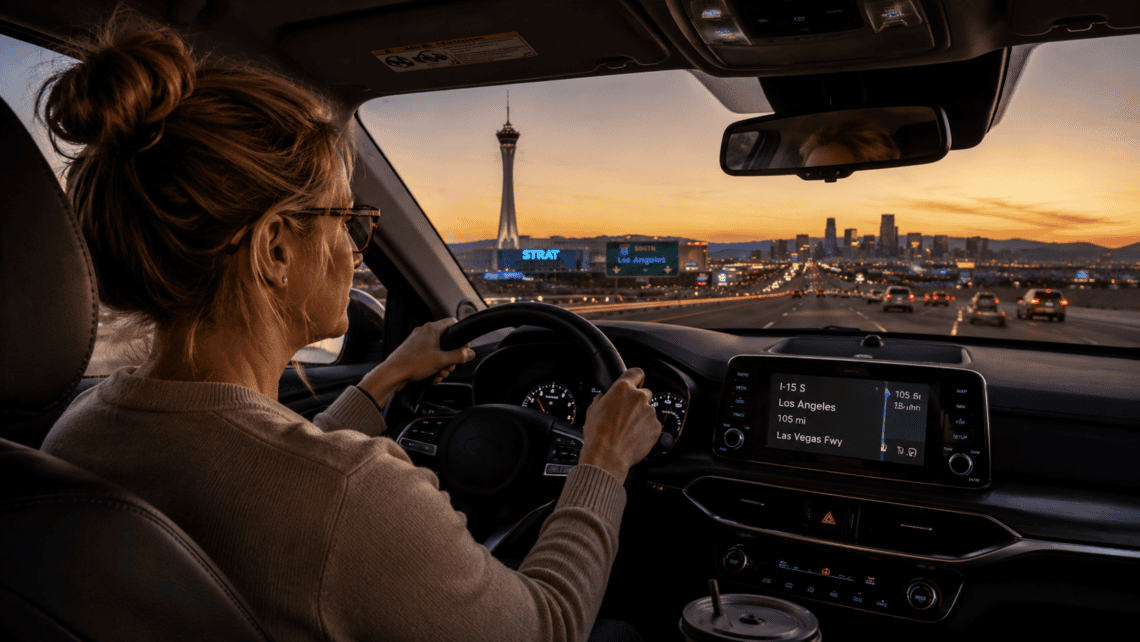
Los Angeles sits about 270 miles from Las Vegas, and the drive takes roughly 4 to 5 hours depending on where you start, where you’re headed, and how bad the traffic is that day.
That’s the short answer. But I’ve made this trip more times than I can count, and the real answer depends a lot on how you travel and when you leave.
So let me walk you through all of it: the drive, the flight, the bus, and the high-speed train that’s coming. By the time you’re done reading, you’ll know exactly how to plan your trip between these two cities.
The Quick Numbers
- Driving distance: about 270 miles via Interstate 15
- Drive time: 4 to 5 hours without major traffic
- Straight-line (flying) distance: about 229 miles
- In-air flight time: roughly 45 to 50 minutes
- Total airport-to-airport flight time: around 1 hour 15 minutes gate to gate
Those are the headline figures. Now here’s what they actually mean when you’re the one making the trip.
Driving from Los Angeles to Las Vegas
Almost everyone drives this route, and for good reason. It’s direct, it’s scenic in a stark desert way, and once you factor in airport hassle, it’s often just as fast as flying.
The main road is Interstate 15. You’ll head out of the Los Angeles area, climb through the Cajon Pass, roll past Barstow, cross the Mojave Desert, and cruise right into Las Vegas. It’s one long, mostly straight shot.
Under good conditions, plan on about 4 hours of actual driving. Realistically, budget closer to 5 once you add a fuel stop, a bathroom break, or a stretch of slow traffic.
Watch Out for Traffic
Here’s the part a lot of first-timers get wrong: the drive time depends heavily on when you leave.
Sunday afternoons and evenings are the worst, because that’s when the entire weekend crowd is driving back to Southern California at the same time. The stretch through the Cajon Pass and around the state line can crawl.
If you can, leave early in the morning or drive on an off-peak day. A trip that takes 4 hours on a quiet Tuesday can easily stretch to 6 or 7 hours on a holiday Sunday.
Gas Up Before the Desert
There are long stretches on I-15 where you won’t see a gas station for a while. Fill your tank before you hit the open desert, especially if you’re driving an older car or towing anything.
In summer, the desert heat is no joke. Keep an eye on your engine temperature, carry water, and don’t push a struggling vehicle across the Mojave in July.
Fun Stops Along the Way
One of the best things about driving is the freedom to stop. A few worthwhile detours between the two cities:
- Calico Ghost Town near Barstow, a restored old mining town
- Mojave National Preserve, wide-open desert landscapes and sand dunes
- Primm, right at the Nevada state line, with outlet shopping and a roadside stop
- Route 66 towns and quirky roadside Americana scattered along the way
If you have the time, the LA-to-Vegas drive makes a genuinely fun road trip rather than just a way to get from point A to point B.
Flying from Los Angeles to Las Vegas
The flight itself is short. The actual time in the air between LAX and Harry Reid International is only about 45 to 50 minutes, one of the quickest hops you’ll ever take.
Gate to gate, once you count boarding, taxiing, and getting off the plane, plan on around 1 hour and 15 minutes.
Plenty of airlines fly the route nonstop, including Southwest, American, Delta, United, JetBlue, Spirit, and Frontier. There are more than a dozen departures a day, so you’re rarely stuck waiting for the next flight.
Is Flying Actually Faster?
This is the honest question worth asking. The flight is under an hour, but that’s not the whole story.
By the time you drive to the airport, park, get through security, wait to board, fly, land, and get out of the terminal on the other end, your total travel time often lands close to what you’d spend just driving.
Flying makes the most sense if you don’t want a car in Las Vegas, you’re short on time, or you snag a cheap fare. Driving wins if you want your own vehicle, you’re traveling with a group, or you like the freedom to stop along the way.
Taking the Bus
Buses run this route too, and they can be surprisingly affordable if you book ahead. Companies like FlixBus offer budget fares with WiFi and comfortable seats, and luxury shuttle services run smaller vans for travelers who want more comfort.
The tradeoff is time. A bus typically covers the route in 5 to 7 hours, longer than driving yourself, since it makes stops and can’t dodge traffic. But if you’d rather relax than drive, and you’re watching your budget, it’s a solid option.
What About a Train?
Right now, there’s no passenger train running directly between Los Angeles and Las Vegas. But that’s changing.
A high-speed rail line called Brightline West is under construction, running 218 miles between Las Vegas and Rancho Cucamonga in the greater Los Angeles area, mostly down the median of I-15.
When it’s finished, the all-electric trains are expected to hit speeds up to 200 mph and make the trip in about 2 hours, roughly twice as fast as driving. The Rancho Cucamonga end will connect to Metrolink for a ride into downtown LA.
The catch is timing. Construction broke ground in 2024, and as of now the line is targeting a completion date of late 2029. So it’s coming, but it won’t be an option for a while yet.
Which Way Should You Go?
Here’s how I’d think about it:
- Drive if you want your own car in Vegas, you’re splitting gas with a group, or you enjoy a good road trip with stops.
- Fly if you’re short on time, you don’t need a car, or you find a fare that beats the cost of gas.
- Take the bus if you want the cheapest option and don’t mind a longer ride.
- Wait for the train if you’re reading this a few years from now and Brightline West is finally running.
For most people making the trip today, driving is the go-to. It’s flexible, it’s cost-effective with a full car, and the desert scenery is part of the experience.
Thinking About Making the Move Permanent?
A lot of people make this drive as a weekend getaway and start wondering what it would be like to live on the Las Vegas side of it. No state income tax, more house for your money, and a quick trip back to Southern California whenever you want it.
If you’re thinking about buying or selling a home in Las Vegas, or you want to compare what your budget gets you here versus in LA, my team and I would love to help. We serve the entire Greater Las Vegas area, from Summerlin to Boulder City and everything in between.
Give us a call at 702-604-7739 and let us know what you’re looking for. We’ll connect you with the right agent to match your needs.
As an Amazon Associate, I earn from qualifying purchases. Some links on this site are affiliate links. Portions of this content are generated by AI.